
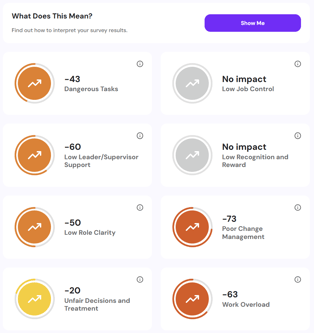
The FlourishDx Work Factors Risk Assessment dashboard provides two main types of scores to help understand psychosocial risk across a group: Hazard Exposure Scores, and Total Risk Scores.
All scores start with a response from a person. The person responds to three questions about each hazard:
-
What is the severity of impact?
-
What is the duration of impact?
-
What is the frequency of impact?
Based on the person's responses, the platform calculates an exposure score for each hazard, using a 100 point scale. Each person has an exposure score for every hazard presented. This represents the person’s unique hazard profile.
The platform also calculates a risk score for each person. The risk score accounts for the cumulative impact of being exposed to more than one hazard. A person’s risk score is calculated from their unique hazard profile, based on their top-scoring hazards. It is not an average of their hazard scores, it is a cumulative calculation.
The dashboard and report provide aggregated results across groups. The hazard exposure score in the dashboard shows the average score for that group. The same applies to the overall risk rating – it shows the average risk score for that group, along with the distribution of risk scores.
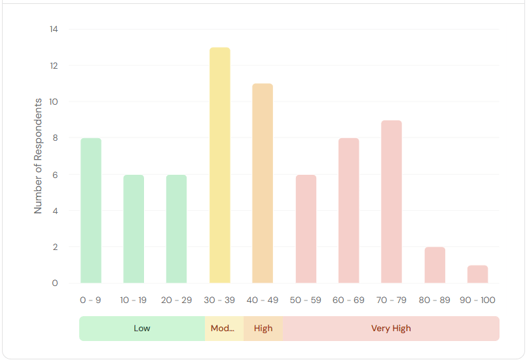
How can we have a high risk score when hazard exposure scores are in the low range?
Each unique hazard profile will be slightly different. For some teams, there will be greater consistency between unique hazard profiles. This will tend to produce higher aggregate scores for hazard exposure as people will generally be reporting similar levels of impact for the same set of hazards. For other teams, there may be less consistency between unique hazard profiles. This may be due to greater variation in roles and responsibilities within a team (e.g. a team where each person has a unique specialisation requiring them to work with different stakeholder groups), or down to personal preferences and work styles being varied within the group. In these cases, the hazards that are impacting one person may be very different to the hazards impacting another person.
For example (note this is a simplified scenario for the purposes of demonstration):
- James reports High exposure to work overload, fatigue, inadequate support from leadership, and poor job security, which results in a High risk score.
- Sarah reports Very High exposure to customer aggression and violence and isolated work, High exposure to low recognition and reward, unfair decisions and treatment, and poor interpersonal relationships. This results in a Very High risk score.
- The three other team members report moderate or low exposure to those hazards, two people with a Moderate risk score and one with a Low risk score.
- While the average exposure score for each hazard is moderate or low, the cumulative risk to James and Sarah is high. This means that the overall risk score for the group is High, despite the low to moderate averages for hazard scores.